

Mochi Melon Was a Last Minute Add and Took #1 Hybrid and Overall Best at NECANN
The funniest part about Mochi Melon winning at the 2026 NECANN competition is that it almost stayed home.
Not “almost” in the dramatic movie-trailer sense. More like the very real, very cannabis-room kind of almost, where jars are open, opinions are flying, someone is probably holding a nug too close to their face, and the team is trying to make the call without overthinking it into the ground.
We had our lineup. We felt good about it.
Peanut Butter Pie for Indica
Cherry Piston for Sativa
Permanent Gas for Hybrid
That made sense. Those jars had a case. They showed up strong. On paper and in the room, we could stand behind them.
Then there was Mochi Melon.
It was not the obvious answer at first. It was not the one circled in red from the jump. It was the jar that kept interrupting the conversation. Somebody would move on, then come back to it. Somebody would crack it again. Somebody would say, “Hold up, smell this one more time.”
That is usually when flower starts telling on itself.
Mochi Melon got added last. Then it took #1 Hybrid Flower. Then it took Overall Best.
So yeah, cannabis is funny like that.
The jar that would not leave us alone
Every grower knows this part of the process. The spreadsheet says one thing. The COA says another. The room says something else entirely.
At Indigo East, we care about the numbers. We study every COA. We look at cannabinoid profiles, terpene expression, batch notes, harvest data, dry and cure behavior, all of it. We are not guessing in the dark.
But there comes a point where the flower has to leave the paperwork and stand in the actual world.
That means opening the jar.
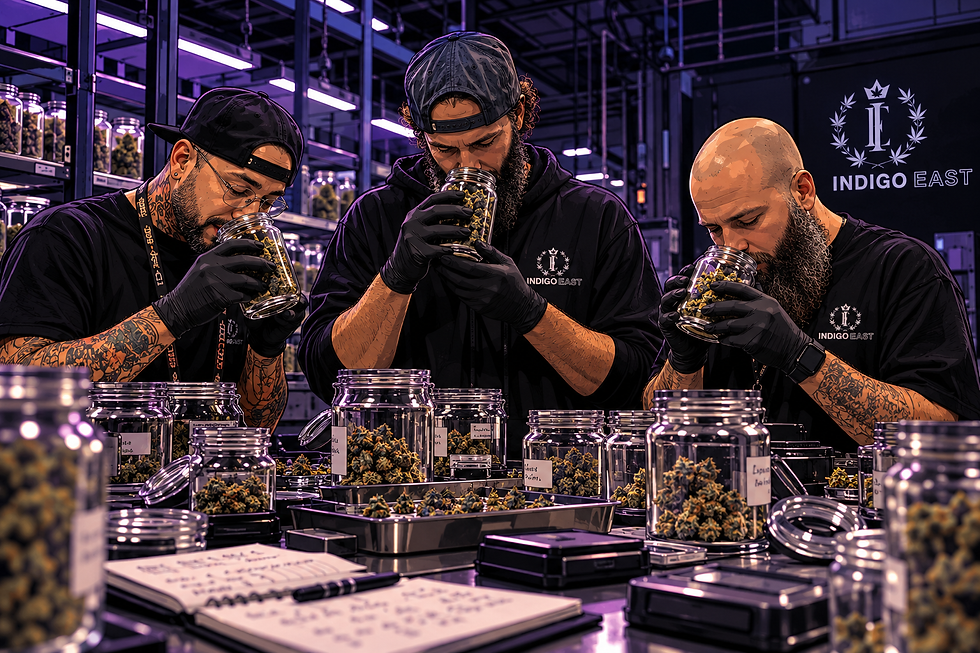
Mochi Melon kept making its way back into our hands because it had that pull. Not a loud, fake-loud thing. Not the kind of flower that tries to win you over by
screaming one note at you. It had layers. It had shape. It had the kind of nose that makes a room get quiet for half a second before everyone starts talking at once.
That is not science versus instinct. That is science meeting the part of cannabis that still has to be experienced.
A lab can tell you what’s in the jar. It can’t tell you which jar you’re going to keep opening.
That line became the whole lesson.
Because the legal market has made certain things extremely visible. THC percentages. COAs. Packaging. Menus. Category names. Strain names with nine-part family trees. None of that is bad. We’re in the legal market too. Transparency matters. Testing matters. Consistency matters.
Still, anyone who has spent real time with flower knows the same thing: the best jar is not always the one with the biggest number next to it.
Sometimes the batch you keep reaching for tests lower than the one you thought would dominate. Sometimes the terpene profile reads one way, then the smoke tells a more complete story. Sometimes a cultivar looks good, smells good, breaks down right, rolls clean, burns the way it should, and leaves you staring at the jar like, “Yeah, that’s the one.”
That was Mochi Melon.
We almost let the numbers make the decision
The temptation is real.
When you are entering a competition, especially one that people in the Northeast cannabis scene actually pay attention to, it is easy to start trying to “solve” the entry. You can talk yourself into treating it like a math problem.
This one has the stronger COA.
That one has the louder lab profile.
This one checks the category box cleaner.
That one looks like the safe pick.
Safe picks are comfortable. They are also how good flower gets left behind.
We had confidence in Permanent Gas for Hybrid. That was the original plan. There was a reason for it. Permanent Gas has presence. It made sense structurally and on paper. Nobody was mad at that choice.
But Mochi Melon kept coming up.
At some point, the question changed. We stopped asking, “Which one looks best for competition?” and asked the cleaner, more dangerous question:
What would we actually want to smoke?
That question cuts through a lot of noise.
Not what would look best in a pitch deck. Not what would make the easiest caption. Not what has the biggest number to throw on a shelf talker. What would we roll without thinking twice? What would we bring out after dinner? What would we hand to someone whose opinion we respect and say, “Tell me if I’m crazy”?
Coming from the legacy side of cannabis, that is how a lot of us learned flower. Not perfectly. Not romantically. Just directly.
You smelled it. You looked at it. You broke it down. You rolled it. You smoked it. Then everybody in the room knew if it was there or not.
No one needed a 20-minute explanation if the flower did not back it up.
That old-school sensory filter still matters. It does not replace testing. It does not replace compliance. It does not replace clean cultivation practices. It just catches things the paperwork cannot catch by itself.
The density. The snap. The stick without soupiness. The way it comes apart. The way the aroma changes once it is broken down. The nose on it. The finish. The burn. Whether the jar gets revisited or politely ignored.
Mochi Melon kept passing that test.
“Cannasseur” instincts are not a joke
We throw the word “cannasseur” around with a little smirk because, yeah, it is a ridiculous word. It also points to something real.
Experienced flower people build a memory bank. They remember what rushed dry feels like. They remember what muted cure smells like. They remember when something looks great but smokes flat. They remember the difference between pretty flower and flower with a pulse.

That kind of judgment comes from repetition. Runs. Rooms. Mistakes. Wins. Long nights. Annoying debates over whether a batch is actually ready or everyone is just impatient.
At Indigo East, we do not want to lose that edge just because cannabis lives in a regulated market now.
The industry got more formal. The plant did not become less sensory.
Mochi Melon winning was a reminder of that. It was the jar that asked us to trust our own taste. Not blindly. Not stubbornly. Just enough to say, “We know what we’re smelling. We know what this is doing. Put it in.”
That is what happened.
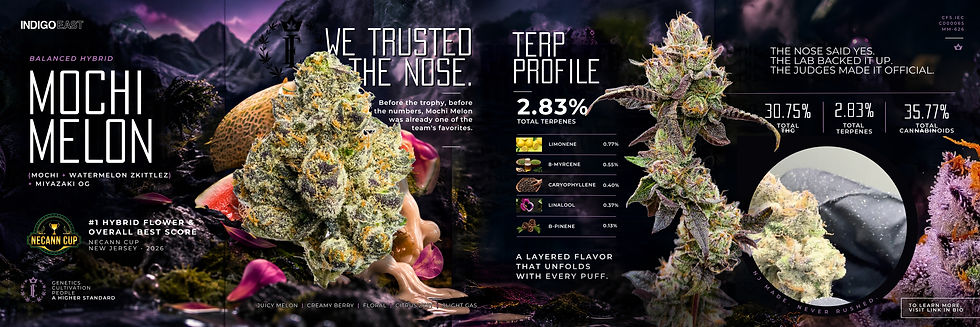
The Mochi Melon strain had enough character to pull the room back again and again, and eventually we listened. For anyone following Mochi Melon cannabis because of the NECANN result, that is the part we hope lands: this was not chosen by chasing a number. It was chosen because the flower kept making the argument itself.
The legal market needs both the lab and the lighter
New Jersey cannabis has grown fast. Fast enough that people are still figuring out what they trust.
Some shoppers lead with THC. Some want genetics. Some ask about cannabis terpenes. Some trust budtenders. Some buy with their nose when deli-style is an option. Some follow cultivators because they have been burned by pretty packaging before.

All of that makes sense.
The legal market trained people to look at labels because labels are what people can see. A percentage feels concrete. A test result feels official. A package can make a product feel dialed before anyone opens it.
We are not here to clown that. Lab testing is part of doing this right. COAs can tell you a lot. They can show safety data, cannabinoid content, and terpene presence. They help operators track batches and improve. They help buyers compare products when they do not have access to the flower itself.
But no COA can tell you the whole smoking experience.
It cannot tell you which jar your crew will finish first.
It cannot tell you which batch has that weird little finish that keeps you curious.
It cannot tell you when structure, moisture, aroma, cure, and flavor line up just right.
That is why the Indigo East Cannabis approach is simple enough to fit on the wall and annoying enough to argue about every harvest:
Respect the science. Study the numbers. Then smoke the flower.
That last part matters.
Not because we are anti-data. Because we are pro-flower.
Lower-testing batches have humbled everybody
Anyone who has worked around cultivation long enough has been humbled by a batch that did not behave according to expectation.
A higher-testing run comes down, and everyone assumes it will be the favorite. Then another batch, quieter on paper, starts disappearing from the personal stash jar.
That does not mean numbers are fake. It means flower is more complex than one metric.
The plant expresses itself through a lot of moving pieces. Genetics, environment, timing, handling, dry, cure, storage, age, and the way compounds interact all play into what someone experiences when they actually consume it. Even then, people have preferences. Some people like sharp gas. Some like fruit. Some want funk that puts a dent in the room. Some want something cleaner and more delicate.
The best growers pay attention to all of it without pretending there is one magic score.
That is especially true for a NJ cannabis cultivator trying to build something with staying power. You cannot fake repeat interest forever. People might buy the first jar because of a number, a name, or a win. They come back because the flower made sense once it was in their hands.
Mochi Melon earned its spot that way internally before it ever earned anything externally.
Mochi Melon: #1 Hybrid and Overall Best
Winning #1 Hybrid Flower at the NECANN cannabis competition mattered. Taking Overall Best after that mattered too.Mochi Melon taking #1 Hybrid and Overall Best at NECANN mattered to us. A lot.
We are proud of it. Of course we are. We are growers. We are not pretending we shrugged and went back to watering plants like nothing happened. There were smiles. There was probably some loud Jersey behavior. Nobody needs to investigate that too deeply.

But the point is not that one trophy suddenly explains Indigo East.
The point is that the path to that win says a lot about how we make decisions.
We are not trying to build flower for a spreadsheet. We are not trying to sand off every edge until the brand sounds like it was assembled in a conference room. We are not chasing every market trend just because the menu changed this week.
We are building from the plant out.
That means genetics have to be selected with real intent. Rooms have to be run with discipline. Batches have to be judged honestly. If something is not there, it is not there. If something surprises us, we pay attention. If a jar keeps calling people back, we do not ignore it because another jar looked better on paper.
Mochi Melon was the last-minute add. It became the proof.
Not proof that instincts beat science. That would be lazy.
Proof that the best decisions often come when the lab work, the cultivation work, and the human beings in the room all get a vote.
Jersey flower should have a point of view
There is a certain attitude we think New Jersey flower should have.
Not loud for the sake of loud. Not gimmicky. Not trying to cosplay the West Coast or copy whatever name is hot on the wholesale sheet. Jersey has its own pace, its own edge, its own bullshit detector.
People here can smell when something is over-polished. They can also tell when something is real.
That is the lane Indigo East is interested in. Grown seriously, judged honestly, and shared without pretending cannabis needs a velvet rope to be worth respecting.
Mochi Melon fits that energy because its story is not too clean. It did not cruise in as the chosen one. It had to annoy us into paying attention. It had to survive the second smell, the third look, the final debate.
Then it went and handled business.
That is very Jersey, honestly. Slightly underestimated, added late, then leaves with the whole thing.
Keep opening the right jars
The Mochi Melon win gave us a moment, but the bigger thing is what comes next.
We will keep reading the COAs. We will keep studying harvests. We will keep dialing rooms, watching genetics, arguing over cure, and making the kind of calls that do not always fit neatly into a lab result.
Then we will keep opening jars.
Because that is where the truth still lives.
If you want to see what we are growing and what is coming through the lineup, check out Indigo East cultivars. Follow the work, ask your budtender what is fresh, and when you get a jar in your hands, give it the same test we gave Mochi Melon.
Smell it. Look at it. Break it down. Roll it. Smoke it.
Either it is there or it isn’t.


Comments